Authorized AMSOIL Dealer
Joseph Feghali
Miami, FL

1982 Oldsmobile Calais 4.3L Oil Type and Capacity

Free Vehicle Maintenance App

For cars, trucks, ATVs & more

Track oil changes, save service records, and get maintenance reminders.

Keep your maintenance history handy for your next service.

Your Vehicle's Information

Year:

1982

Make:

Oldsmobile

Model:

CALAIS

Engine Size:

4.3L

Engine #:

[8]

Recommended Synthetic Oil for a 1982 Oldsmobile Calais 4.3L

Product Name Product Description Capacities Product
Signature Series 10W-30 Synthetic Motor Oil Get the best synthetic oil for your Calais now! Save time and money and protect your Oldsmobile. With filter 5 quarts After refill check oil level. ATMQT-EA
Signature Series 10W-30 Synthetic Motor Oil ATMQT-EA
Add To Cart
Add To Cart
XL 10W-30 Synthetic Motor Oil Protect your Calais with Amsoil and support the best MADE in USA oil! With filter 5 quarts After refill check oil level. XLTQT-EA
XL 10W-30 Synthetic Motor Oil XLTQT-EA
Add To Cart
Add To Cart
OE 10W-30 Synthetic Motor Oil AMSOIL OE Synthetic Motor Oil is specially made for the extended oil change intervals recommended for your 1982 Oldsmobile Calais 4.3L engine. It has advanced synthetic technology that resists chemical breakdown for maximum wear protection for your vehicle which is well beyond the traditional 3,000-mile oil change interval. Get the best synthetic oil now for your Oldsmobile Calais. With filter 5 quarts After refill check oil level. OETQT-EA
OE 10W-30 Synthetic Motor Oil OETQT-EA
Add To Cart
Add To Cart

Recommended oil filters for my 1982 Calais

Product Name Product Description Product
AMSOIL Ea Oil Filters This filter is for your 1982 Oldsmobile Calais and is designed to last up to 25k (normal conditions) or 15k miles (severe conditions) or 1 year, whichever comes first. EAO64-EA
AMSOIL Ea Oil Filters EAO64-EA
Add To Cart
Add To Cart
WIX Oil Filter Wix oil filters for your 1982 Oldsmobile Calais have extended OEM recommendations which match the drain intervals of AMSOIL XL synthetic motor oil which is 12k or 1 year, whichever is first. 51522-EA
WIX Oil Filter 51522-EA
Add To Cart
Add To Cart

Recommended cabin & Air Filters for my Oldsmobile Calais

Product Name Product Description Product
WIX Air Filter Wix Air Filter for your 1982 Oldsmobile Calais. 42098-EA
WIX Air Filter 42098-EA
Add To Cart
Add To Cart

Recommended fuel Filters for my 1982 Calais

Product Name Product Description Product
WIX Fuel Filters Superior fuel cleansing for your 1982 Oldsmobile Calais and it will prevent pump wear, injector clogging, premature engine wear while helping boost your Calais's fuel economy! 33052-EA
WIX Fuel Filters 33052-EA
Add To Cart
Add To Cart

Recommended transmission fluids for my 1982 Calais

Product Name Note Capacities Product Description Product
Signature Series Fuel-Efficient Synthetic Automatic Transmission Fluid Automatic Transmission Fluid
(1) This specification has been updated from Dexron II or III to Dexron VI per a Technical Service Bulletin from the manufacturer
5 quarts Initial Fill 4 speed THM200-4R Total Fill 11 quarts
3.2 quarts Initial Fill 4 speed THM325-4L Total Fill 10 quarts
3 speed THM200C Total Fill 9.4 quarts 3.5 quarts Initial Fill
3 speed THM350C Total Fill 10 quarts 3 quarts Initial Fill
3 speed THM250C Total Fill 10.8 quarts 4 quarts Initial Fill
If a lighter viscosity is needed then this automatic transmission fluid provides top-notch protection! Recommended for Toyota, Ford, and General Motors transmissions. You will get the same awesome protection as Amsoil's Signature Series Multi-Vehicle automatic transmission fluid. Also recommended for vehicles that need GM DEXRON® VI, Ford MERCON® LV and SP, Honda DW-1, Nissan Matic-S, and Toyota WS fluid specifications. ATLPK-EA
Signature Series Fuel-Efficient Synthetic Automatic Transmission Fluid ATLPK-EA
Add To Cart
Add To Cart
OE Fuel-Efficient Synthetic Automatic Transmission Fluid Automatic Transmission Fluid
(1) This specification has been updated from Dexron II or III to Dexron VI per a Technical Service Bulletin from the manufacturer
5 quarts Initial Fill 4 speed THM200-4R Total Fill 11 quarts
3.2 quarts Initial Fill 4 speed THM325-4L Total Fill 10 quarts
3 speed THM200C Total Fill 9.4 quarts 3.5 quarts Initial Fill
3 speed THM350C Total Fill 10 quarts 3 quarts Initial Fill
3 speed THM250C Total Fill 10.8 quarts 4 quarts Initial Fill
Outstanding protection and resists varnish! Change interval based on your Calais owner's manual. OTLQT-EA
OE Fuel-Efficient Synthetic Automatic Transmission Fluid OTLQT-EA
Add To Cart
Add To Cart

Recommended coolants for my Oldsmobile Calais

Product Name Product Description Capacities Product
Passenger Car & Light Truck Antifreeze & Coolant maximum protection for your 1982 Oldsmobile Calais under extreme temperatures and operating conditions! Lasts up to 150,000 miles or five years! (whichever comes first) ANTPC1G-EA
Passenger Car & Light Truck Antifreeze & Coolant ANTPC1G-EA
Add To Cart
Add To Cart
Low Toxicity Antifreeze and Engine Coolant Lasts in your 1982 Oldsmobile Calais for up to 150,000 miles or five years! (whichever comes first). Biodegradable! ANT1G-EA
Low Toxicity Antifreeze and Engine Coolant ANT1G-EA
Add To Cart
Add To Cart

Maintaining Lubrication Standards for the 1982 Oldsmobile CALAIS 4.3L

Proper engine maintenance is a cornerstone of long-term vehicle health, particularly when managing an engine that has been in operation for several decades. For the 1982 Oldsmobile CALAIS equipped with the 4.3L engine, consistent attention to lubrication and routine inspections can help ensure the mechanical components continue to operate as intended.

Monitoring Fluid Integrity and Potential Leaks

One of the most effective ways to monitor the health of a vehicle's lubrication system is through regular visual inspections. Over time, various seals and gaskets may experience changes in their ability to contain fluids. When performing routine checks, it is useful to look for any signs of seepage or active leakage around the engine block and associated components. If you notice dark staining or wetness on the underside of the engine or near sealing surfaces, this warrants further investigation. It is important to remember that a single symptom, such as a small puddle or an oily residue, can be associated with several different causes. Rather than attempting to diagnose a specific component failure immediately, focus on identifying where the fluid is originating. Consistent monitoring allows you to address minor seepage before it potentially leads to more significant issues. In addition to checking for external leaks, observing the appearance of the oil itself can provide useful information. If the lubricant appears excessively dark, gritty, or shows signs of unusual contamination, it may indicate that the service interval has been exceeded or that there is an underlying issue with the engine's internal environment.

Observing Changes in Engine Operation

Beyond visual inspections for leaks, paying close attention to how the vehicle behaves during operation can serve as an early warning system. While many mechanical issues are not immediately apparent, certain changes in performance or sound may indicate that the lubrication system requires attention. For example, unusual mechanical noises that occur during startup or while the engine is idling should be investigated. Similarly, if you notice a change in how the engine responds to throttle inputs, it can be helpful to cross-reference this with your recent maintenance history. If any warning indicators appear on the dashboard related to fluid levels or pressure, these require immediate investigation to prevent potential damage. It is also beneficial to monitor for any unusual odors that may arise during driving. A burning smell can sometimes be associated with oil contacting hot engine components, which might suggest a leak from a gasket or seal that has not yet formed a visible puddle on the ground. Always treat new or changing symptoms as an opportunity to perform a more thorough inspection of the engine bay.

Prioritizing Maintenance for Aging Vehicles

As vehicles age, maintenance strategies often shift from purely preventive measures to a more condition-based approach. For an owner of a 1982 Oldsmobile CALAIS, this means using the current physical state of the vehicle to determine where to focus your efforts. If you are stepping into ownership without a complete service history, establishing a maintenance baseline is a practical first step. This involves performing a comprehensive inspection of all fluids and major engine components to understand the current "starting point" of the vehicle's condition. Once this baseline is established, you can more accurately track changes over time. When managing an older engine, it is often more effective to address active concerns—such as a detected leak or a change in fluid color—before moving on to speculative repairs. Distinguishing between necessary maintenance and unnecessary parts replacement is key to efficient ownership. Instead of replacing components simply because they have reached a certain age, focus on inspecting aging materials like hoses (if present) or belts (if equipped) for signs of cracking, glazing, or fraying. This ensures that your maintenance budget is directed toward the areas that actually require attention.

The Role of Lubrication in Engine Longevity

Engine oil performs several vital roles that are essential for the continued operation of the 4.3L engine. Beyond simply reducing friction between moving parts, the lubricant plays a significant role in managing the thermal environment within the engine. As the engine operates, heat is generated through combustion and mechanical movement; the oil helps to carry this heat away from critical areas, assisting the overall cooling process. Furthermore, the chemical properties of the oil are designed to manage the internal environment by controlling the buildup of deposits. Over long periods of operation, various byproducts can accumulate within the engine. A high-quality lubricant with strong deposit-control characteristics helps to keep these surfaces clean, which is vital for maintaining consistent mechanical performance. Maintaining a regular schedule for fluid changes ensures that the additives within the oil—which are designed to manage oxidation and provide protection—remain at effective concentrations. When the oil becomes depleted or heavily contaminated, its ability to protect the engine diminishes, making regular service an essential part of long-term ownership.

Practical Steps for Long-Term Record Keeping

Maintaining a detailed history of all services performed on the 1982 Oldsmobile CALAIS can be an invaluable tool for both the current owner and any future technicians. A well-kept logbook should include more than just dates and mileages; it should ideally document specific observations made during inspections. For instance, noting that a particular seal showed minor seepage during a routine check allows you to track whether that seepage is increasing or remaining stable over several months. Documenting the specific brands and types of filters and lubricants used ensures consistency in future service. This level of detail helps in distinguishing between a sudden mechanical change and a gradual, expected progression of age-related wear. If you are managing a vehicle with an incomplete history, your first priority should be to document every new service performed from this point forward. This creates a new, reliable baseline that makes future troubleshooting much more straightforward.

Buying Engine Oil for the 1982 Oldsmobile CALAIS 4.3L

When it is time to replenish your engine's lubricant, the most important step is to ensure the product matches the specific requirements of your application. For this vehicle, you should match the engine oil to the application-specific viscosity information already displayed on this webpage. Before making a purchase, always check the product labeling to verify that the oil meets the appropriate API certification for your needs. While there are many options available on the market, including conventional, synthetic blends, and full synthetic formulations, the choice should be guided by the technical specifications provided in your vehicle's documentation. Some high-mileage oil formulations contain additives intended for use in aging engines, such as seal-conditioning agents, which may be a consideration depending on the observed condition of your engine's gaskets and seals. However, rather than making assumptions based solely on the age of the vehicle, always prioritize the specific viscosity and quality standards listed in the application information provided here to ensure optimal compatibility with your 4.3L engine.
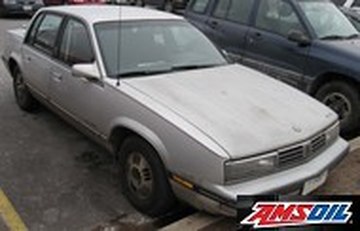
Catalog vehicle photograph for 1982 Oldsmobile CALAIS
Vehicle photograph from our catalog. Appearance may differ by model or trim.
Visit us on social media